Looking Back on Working From Home and Travel Forecasts
Round 2 of Looking Back at Forecasts I Made
When I started working around 2006, working from home was commonly framed in transportation planning as a lever for reducing vehicle miles traveled. We framed this as a behavioral change that would naturally translate into system-level outcomes.
The behavioral forecast was right
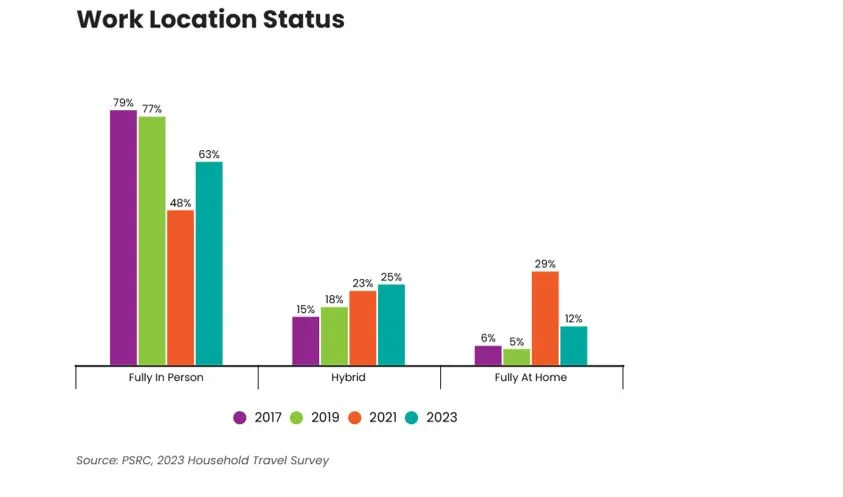
On one level, that forecast was right. Working from home increased dramatically after COVID and remains far more common than it was before the pandemic. According to the American Community Survey, 5.7% of U.S. workers usually worked from home in 2019, compared with 13.3% in 2024. (I’m using ACS even though the question wording is atrocious — a topic for another day.)
The number of work trips made by people working from home did indeed go down, as shown in PSRC and MTC travel surveys. Peer-reviewed research shows that reductions in onsite work are associated with modest reductions in VMT and much larger proportional declines in transit ridership.
The system-level inference was not
And yet, at the system level, the outcome looks very different. U.S. DOT data show total vehicle miles traveled above historic highs, with the 12-month moving total exceeding 3.3 trillion miles in 2025. Even with far more remote and hybrid work than we ever imagined in 2006, aggregate driving has not declined in a durable way. Reduced commute demand translated quickly into lower transit ridership, while auto travel proved far more resilient. Roads absorbed the change; transit reflected it.
Inelasticity of auto VMT is unfortunately a strong characteristic of the U.S. built environment. By around 1990, the basic shape of U.S. transportation and land use was already in place. Working from home changed behavior at the margins, sometimes meaningfully so, but it did not undo decades of investment and spatial patterning. Marginal behavior change, even when widespread, cannot on its own overcome deeply entrenched structure.
What planners should take from this
As planners, the lesson is that we need to be more careful about how we translate behavioral change into promises about system-level outcomes. There is only so much we can do at an aggregate scale to change usage without giant policy or systems change. There isn’t a magic bullet to reduce VMT.
That’s also why I like to focus back on improving individual experiences these days — helping people get to the activities that make them thrive, instead of looking at system metrics — because that’s where we could actually make a difference.
Related: In 2022 I presented on the COVID-era impacts on work, VMT, and travel behavior to the PSRC Transportation Demand Management committee. View the presentation.