Women's Diverse Travel Needs Often Go Overlooked
Originally published on Sound Data Stories, PSRC’s data blog, March 2023.
Women have transportation needs that have not historically been met in urban environments. The regional transportation system was traditionally designed around the need to quickly get to work at central locations at peak periods. Women tend to carry significantly more of the care-giving burdens of society and thus need a system that works safely for traveling with others to a variety of locations at all times of day. Women also represent a large portion of older populations who have unique transportation needs that are not well-served by a system built around driving and work destinations. Women, especially women of color, are more likely to live in poverty and have lower earnings for the same jobs as men, which impacts many aspects of transportation needs.
With the arrival of the COVID-19 pandemic, we saw a greater trend towards telecommuting for some people and continued trends in aging. Housing prices continue to soar and childcare options continue to degrade. With these new considerations at play, compounded with the existing burdens on women, when will the transportation system evolve for women across diverse backgrounds?
The Puget Sound Regional Household Travel Survey contains detailed information about travel behaviors by race, ethnicity, gender, income, and location. The 2017, 2019, and 2021 surveys collected day-to-day information from households in the central Puget Sound region: how we traveled, where we went, how long it took, prior to COVID-19 and after.
Travel demands put different pressures on women
Women’s trips are more varied, spread across a broader range of destinations, and are more likely to primarily serve the needs of someone else. Women are more likely to live in a car-free or car-light household, take more trips with other people, take fewer single-occupant car trips than men, and are more likely to carpool or get a ride from a family member or friend if they don’t have a driver’s license.

Women in households with more than two people tend to travel more with other people than men. Transit is often not well set up for people who are traveling with strollers. The walk and bike network are not built out for people of all ages to use.
[Interactive charts showing trip purpose by gender and trips by number of travelers are available in the original post.]
Gender and race intersect in transportation needs
Some women of color experience poverty and low auto ownership at much higher rates than others. Women in some racial groups experience greater disparity in earnings compared to other racial groups. Other women experience greater differences compared to men. Learn more about how we can redesign and shape our cities through a more equitable process in Leslie Kern’s book Feminist City.
Women of color use transit most
Women of color in the region used transit on more of their trips than men and white, non-Hispanic women, prior to COVID-19. Women of color used transit on nearly double the share of their trips as compared to white, non-Hispanic women. Women of color most likely used transit more than white, non-Hispanic women because of having lower incomes, fewer autos, and living in more transit-friendly areas, but more data is needed to confirm this hypothesis.
[Interactive transit use by gender and race chart available in the original post.]
Women bike far less than men
Women bike much less than men, regardless of race, ethnicity, or income. Some of this is undoubtedly because bike network design does not feel well-suited or safe for all people of different ages and abilities.
In 2019, only 6,000 bike trips were made by non-binary folks in the central Puget Sound region, and 30,000 by women, but 74,000 by men.
Regional and nationwide data show similar constraints
Women take shorter, more local trips. In the central Puget Sound region, women’s median trip distance is around 3 miles, while men’s median trip distance is around 4 miles (source: 2017/2019 Household Travel Survey).
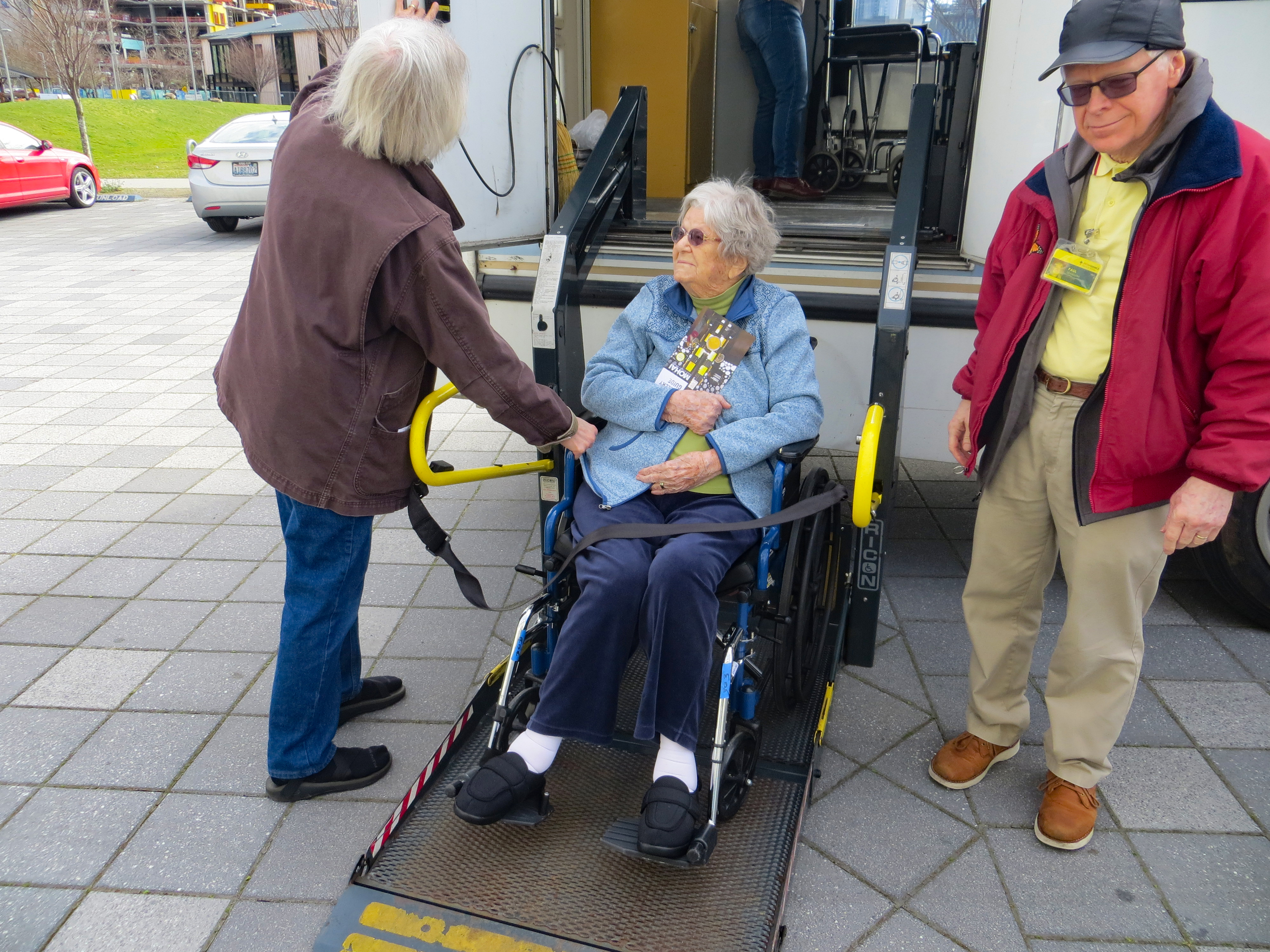
On average, women tend to live longer than men, so at older ages there are many more women who have unique travel needs. Women represent a greater share of the older population who need more specialized transportation services.
Changes brought about by COVID-19
Although there were apparent disparities in the 2017/2019 data, COVID-19 brought abrupt changes to the transportation landscape in 2021. The 2021 Household Travel Survey showed big changes in travel behavior. More people were walking and biking, and fewer people were using transit.
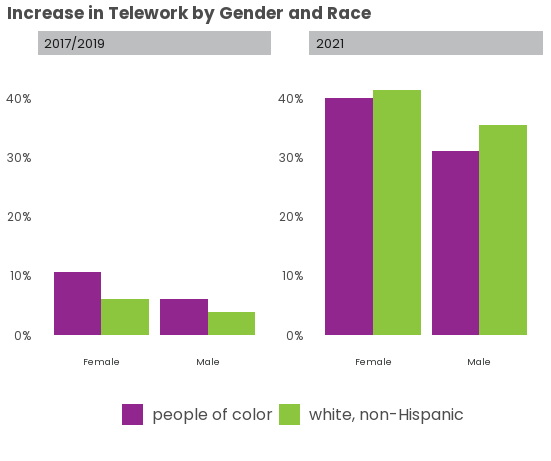
Women teleworked more than men before COVID-19, and the data shows this increased even more in 2021. In 2021, 41% of women teleworked, compared to 33% of men.
Women of color continued to use transit more during COVID-19
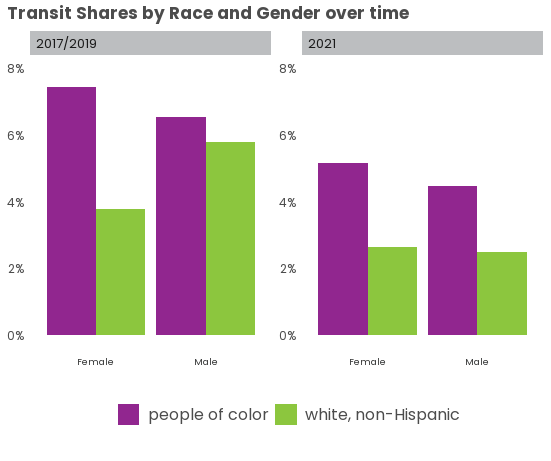
Post-COVID-19, people of color continued to use transit more than white, non-Hispanic people. Women of color were still more likely than white, non-Hispanic women to ride transit. The largest drops in transit mode share were for white, non-Hispanic men.
Trip purposes by gender changed from 2017/2019 to 2021
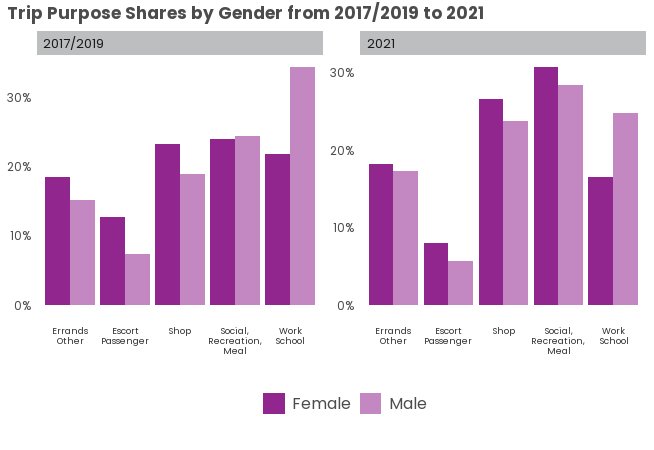
COVID-19 brought about an increase in social, recreational, or restaurant/meal pick-up trips in 2021 for both men and women, but women surpassed men in the percentage of these trips.
Conclusion
With increased care-taking demands, and with women more likely to live in poverty and having less employment and lower incomes than men, there are many aspects of transit and transportation modes that need to be reassessed to support women’s needs. Women of color need a robust transit network with more reliable service throughout the day. Biking, walking, and transit don’t always feel accessible or safe, and access to a vehicle isn’t always available to women.
Transit, especially, needs to be designed around women of color, since they use transit more than other groups.
Download the data used in this analysis.
Related: What Does ‘Transportation Need’ Mean at a 30-Year Horizon? · COVID, Work, and Travel: Impacts on VMT and Mode